
Spanish Bayonet
Yucca baccata Torr.
Also called Yucca, Banana Yucca and Datil yucca.
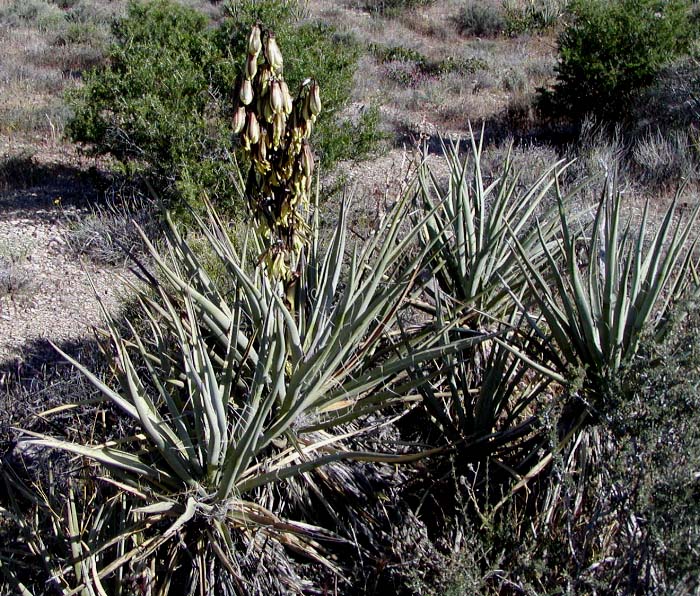
Yucca baccata is a shrub or tree in the asparagus family (Asparagaceae). Its native range is Southeastern Nevada to Northern Mexico. It grows mainly in subtropical climates.
At a glance
- Native range: Southeastern Nevada to Northern Mexico.
- 1 traditional use is on record, from 1 source. Most often recorded: snakebite.
- 2 compounds have been reported in it, among them Sarsapogenin and Tigogenin.
- 7 papers in PubMed name it. None is a clinical trial in people.
Where Spanish Bayonet comes from
The Royal Botanic Gardens, Kew records Yucca baccata as native to 9 regions. Botanists divide the world into regions that are usually a country and sometimes a state or an island group.
- North America
- Arizona, California, Colorado, Mexico Northeast, Mexico Northwest, Nevada, New Mexico, Texas, Utah
Traditional uses on record
One use is on record for Spanish Bayonet, in the ethnobotany database of the U.S. Department of Agriculture. A record of use is not evidence that a plant works or is safe.
- Snakebite1 source · Mexico
The source of this record
Cited in the database by short reference only: Eb31: 351.
Citations are given as the U.S. Department of Agriculture's database prints them.
Active compounds in Spanish Bayonet
2 compounds have been reported in Yucca baccata, not counting nutrients such as sugars, fats, minerals and vitamins. All of them are listed below. Amounts are parts per million of the plant part named; 10,000 ppm is 1%.
The activity recorded for a compound comes from laboratory and animal studies of that compound on its own. It does not show that eating or taking the plant has the same effect in a person.
Sarsapogenin
Root
Recorded activity: lowers fever.
Tigogenin
Root
| Compound | Found in | Recorded activity |
|---|---|---|
| Sarsapogenin | Root | lowers fever |
| Tigogenin | Root | None on record |
Known benefits: what the research shows
A benefit is known when it has been tested in people. PubMed, the U.S. National Library of Medicine's index of medical research, lists 7 papers that name Yucca baccata in the title or abstract. 0 are clinical trials in people.
No clinical trial in people is indexed. Whatever this plant does in the human body has not been tested in a controlled study.
What is not on record
- Safety warnings: no poisoning or pregnancy warning is recorded, which is not proof that the plant is safe.
- Drug interactions: none documented. Most plants have never been tested alongside medicines, so ask a pharmacist before using one with a prescription.
Which part of a plant is used, how it is prepared and how much is taken all change its safety. Never eat a wild plant on the strength of a web page, and in the United States call Poison Control at 1-800-222-1222 if someone may have been poisoned.
Where this comes from
Nothing on this page is an estimate of ours. Every figure is counted from a public record, and every label is the record's own, put into plain English.
- Compounds and traditional uses: Dr. Duke's Phytochemical and Ethnobotanical Databases, U.S. Department of Agriculture, Agricultural Research Service (public domain).
- Accepted name and native range: World Checklist of Vascular Plants, Royal Botanic Gardens, Kew, used under a Creative Commons Attribution license.
- Research counts: PubMed, U.S. National Library of Medicine.
- Photo: Wikimedia Commons, CC BY-SA 3.0.
Some kinds of record are left out of every page. How the library is built says which, and why.
This page is general education, not medical advice. It reports what public records say about a plant; it does not recommend using it. Do not use a plant to treat a condition, and do not stop a prescribed medicine, on the strength of a historical record. Talk to a doctor or pharmacist first, especially if you are pregnant, nursing, giving it to a child or taking medication.