
The Science of Contactless Vital Signs — and What's Next
Remote photoplethysmography can recover a pulse from camera video of skin. Here is what the peer-reviewed literature supports today, what is still research, and where camera-based vital signs could go next.
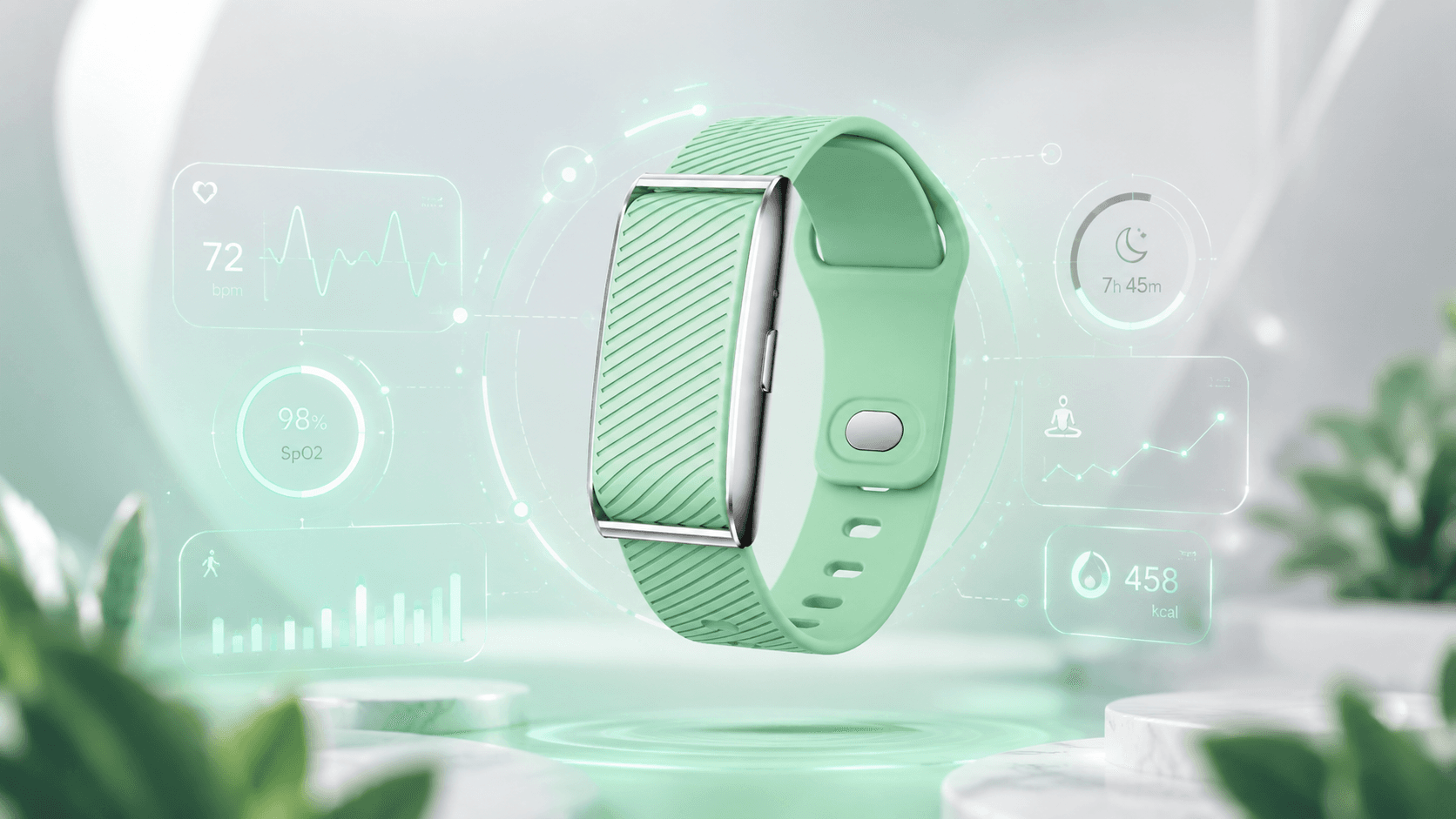
Cameras can see a heartbeat. That is not science fiction, and it is not new.
In 2008, Verkruysse, Svaasand, and Nelson published the foundational paper on remote photoplethysmography (rPPG) in Optics Express. The physics is the same family as the green LED on an Apple Watch or Oura Ring: each heartbeat pushes oxygenated blood into capillaries near the skin, and hemoglobin absorbs green light differently depending on how oxygenated it is. A contact sensor shines a controlled light and reads the reflection. An rPPG system does the same job with ambient light and a camera a foot or two away.
That single idea — recovering a pulse from video of visible skin — is now a serious research field. Heart rate, heart-rate variability, respiratory rate, and atrial fibrillation screening all have peer-reviewed support. Blood pressure, glucose, hydration, and derived “stress” or “biological age” scores are much earlier. This article is a map of that landscape: what the literature can stand behind today, what is still in the lab, and where the next decade of camera-based vital signs could go.
How camera-based pulse measurement works
A photoplethysmogram is a volume-pulse signal. In a watch, the LED and photodiode are pressed to the wrist. In rPPG, the “photodiode” is a CMOS sensor, and the light source is whatever is in the room.
That is why conditions matter so much. Lamp color. Head angle. Motion. Camera focus. Skin tone. The optical signal is real; the noise floor is higher than a contact sensor. From that waveform, research systems extract:
- Beat-to-beat timing → heart rate
- Beat-to-beat variation → HRV
- Low-frequency modulation → respiratory rate
- Waveform shape → features that models then try to map onto blood pressure, oxygen saturation, or metabolic status
The first group is reconstruction of a pulse. The second group is inference from a pulse. Those are different scientific claims.
What the literature supports today
Heart rate is the mature result. Bautista and colleagues at the University of Leeds published a 2023 systematic review and meta-analysis in the Journal of Clinical and Translational Science pooling contactless PPG studies. Heart-rate accuracy was generally above 90% versus reference monitors in controlled conditions. Several FDA-cleared rPPG products report mean absolute errors of 2–5 bpm against ECG. Sit still, give the camera a stable patch of skin and decent light, and the heart-rate number is usually trustworthy.
Atrial fibrillation screening is the strongest clinical use case so far. Gill and colleagues at the University of Birmingham published a 2022 meta-analysis in Heart covering smartphone PPG for AF detection. Pooled sensitivity was above 94%, specificity above 96%. AF is widely under-diagnosed — silent until it causes a stroke — so a short, camera-based screen has real public-health value even when it is not a 12-lead ECG.
Respiratory rate and HRV land in the middle: good in the lab, more fragile in daily use, still useful as directional signals when the recording is clean.
Computer-vision skin analysis is a related but separate line of work. Cameras are good at looking at surfaces. Published classifiers reach high accuracy on common dermatologic presentations in well-lit datasets. That is image recognition, not pulse reconstruction, and it will keep improving as datasets get more diverse.
This is the part of contactless sensing that is closest to being a solved engineering problem: recover the pulse, screen for rhythm irregularity, look at skin.
What is still research
Blood pressure is the most important open question. No smartphone-only method has yet been validated to ISO 81060-2, the international standard a medical-grade cuff has to pass (mean error under 5 mmHg, standard deviation under 8 mmHg, in a representative population). Industry-funded lab papers often report tighter numbers on selected cohorts. Real-world use — different cameras, lighting, motion, and bodies — is a harder test.
Hypertension Canada and the American Heart Association have both taken a cautious position on cuffless blood-pressure technologies: promising, watch this space, not yet a substitute for a properly fitted home cuff. That is the right scientific posture. If diverse-population validation arrives, camera-based estimates could become a useful screening adjunct. Until then, a cuff remains the standard of care.
Glucose is earlier still. The most-cited supporting paper is Avram and colleagues in Nature Medicine (2020). They used smartphone-based vascular signals to detect a population-level diabetes signature with about 81% sensitivity. That is a screening result at the cohort level — people who probably have diabetes — not a claim that the camera measured 142 mg/dL right now. Independent reviews of camera-based glucose estimates report accuracy around 66%. FDA-cleared CGM systems are expected to demonstrate a mean absolute relative difference under 10%. Those are different products answering different questions.
Hydration estimates in the limited literature sit around 76%. Composite “stress” or “biological age” numbers are usually HRV (a real input) run through a scoring layer (a modeling choice). The interesting research is whether those models generalize. Most of them have not been tested that way in public.
An honest comparison against gold standards
| Measurement | Best published camera / rPPG result | What still limits it | Gold standard |
|---|---|---|---|
| Heart rate | 95–98% in good conditions | Lighting, motion | ECG; contact wearables for continuous data |
| HRV | 85–95% in lab settings | Degrades outside the lab | Chest strap, Oura, Whoop, similar contact sensors |
| Respiratory rate | ~90% when still | Motion and talking | Capnography; wearable estimates |
| Atrial fibrillation screening | Sensitivity >94% | Screening, not diagnosis | 12-lead ECG |
| SpO₂ | 85–90% claimed | Highly lighting-dependent | Pulse oximeter |
| Blood pressure | Strong lab reports; not ISO 81060-2 | Population diversity, real-world use | Cuff |
| Blood glucose | ~66% in independent reviews | Not a CGM substitute | CGM or fingerstick |
| Hydration | ~76% | Thin evidence base | Clinical assessment and labs |
| Skin analysis | Up to 97% on common presentations | Lighting and dataset bias | Dermatologist evaluation |
The table is not an argument against the field. It is a picture of a field in motion: pulse and rhythm are ahead; pressure and metabolism are the next scientific hills.
The equity problem the next papers have to solve
Validation data for camera-based vital signs has often been drawn from healthy, lighter-skinned participants. That is a known failure mode in vision systems, and it is solvable.
A 2023 Cureus paper by Talukdar and colleagues evaluated rPPG across skin tones and found that accuracy can be maintained when training data is diverse. The method is not inherently limited to one demographic. It is limited by whether developers do that work, and whether they publish it.
Adjacent computer-vision history is a warning, not a verdict. Buolamwini and Gebru’s 2018 “Gender Shades” study found commercial vision systems with error rates under 1% on lighter-skinned men and up to 35% on darker-skinned women. Xing and colleagues’ 2023 paper in Computers in Biology and Medicine on video-based blood-pressure prediction flagged that BMI is rarely controlled for; when it is, reported accuracy can drop sharply.
The people who would benefit most from low-friction screening — including people with higher BMI, darker skin, chronic conditions, and less access to clinics — are the populations a camera method has to be validated on. That is the research agenda, not a reason to abandon the method.
Spot checks and continuous signals do different jobs
Camera-based rPPG is a spot check. A wearable is a time series.
Neither replaces the other. A short optical reading can meet someone who is not wearing a sensor, or add a pulse estimate to a check-in. A ring or watch can watch overnight HRV, resting heart rate, sleep disruption, and recovery against that person’s own baseline.
That continuity is why the UCSF TemPredict study found Oura Ring detected fever and elevated resting heart rate roughly three days before COVID symptoms, why Mishra and colleagues at Stanford saw similar pre-illness heart-rate shifts in Fitbit data, and why the Apple Heart Study in the New England Journal of Medicine (2019) could identify previously undiagnosed atrial fibrillation in 0.5% of 419,297 participants. Those findings depend on a signal that does not stop when the person puts the phone down.
The productive way to read this is complementary, not competitive. Contactless optical methods lower the barrier to a reading. Contact sensors hold the baseline. Health intelligence gets more useful when both kinds of signal, plus labs and the medical record, sit in the same picture.
Where the science could go in the next decade
Three developments would change the field quickly:
-
Cuffless blood pressure that actually passes ISO 81060-2 in diverse, real-world cohorts. If that validation lands, camera-based estimates become a legitimate screening adjunct rather than a lab curiosity. A three-to-seven-year window is a reasonable guess, not a promise.
-
Better cameras on consumer devices. Infrared and hyperspectral sensors would give optical methods more to work with than today’s RGB phone cameras. Glucose and other metabolic estimates, if they ever become reliable, likely need that extra signal — not just a better model on the same pixels.
-
Published fairness work as a default. Skin tone, BMI, age, motion, and lighting should be reported the way error bars are reported. The Talukdar result already shows the method can hold across skin tones when the dataset does.
Heart-rate spot checks, AF screening for people who do not wear a watch, and skin analysis are the nearest-term uses. Malnutrition-risk screening in older adults is an example of a narrow, validated task: Wang et al. 2023 in Frontiers in Nutrition reported around 73% accuracy against a nutritional assessment. Narrow tasks with a gold-standard comparator are how this field will earn clinical trust.
What we take from the literature
Contactless vital signs are real science. The pulse is in the pixels. Rhythm screening has a clinical story. Blood pressure and glucose are the research frontier, not the settled measurement layer.
Mother Nature AI is built around the data that is already continuous and already in the record — Apple Health, Oura, Whoop, Garmin, Fitbit, our in-development VitalIQ wearable, and FHIR-connected systems such as MyChart — because that is the evidence we can stand behind today. Camera-based rPPG is a field we will keep reading. The parts that are validated belong in the same health picture as wearables and labs. The parts that are still in the lab should stay labeled as research until they are not.
Want a second look at a lab result, wearable trend, or medication question? Mother Nature AI is free to use and grounded in peer-reviewed literature plus the health data you choose to connect.