
Remote Patient Monitoring for Nursing Homes: How Dashboards Help Care Teams See Trends Earlier
Remote patient monitoring for nursing homes is moving from clipboards and spot checks to wearable health data, facility dashboards, family visibility, and AI-assisted trend summaries.
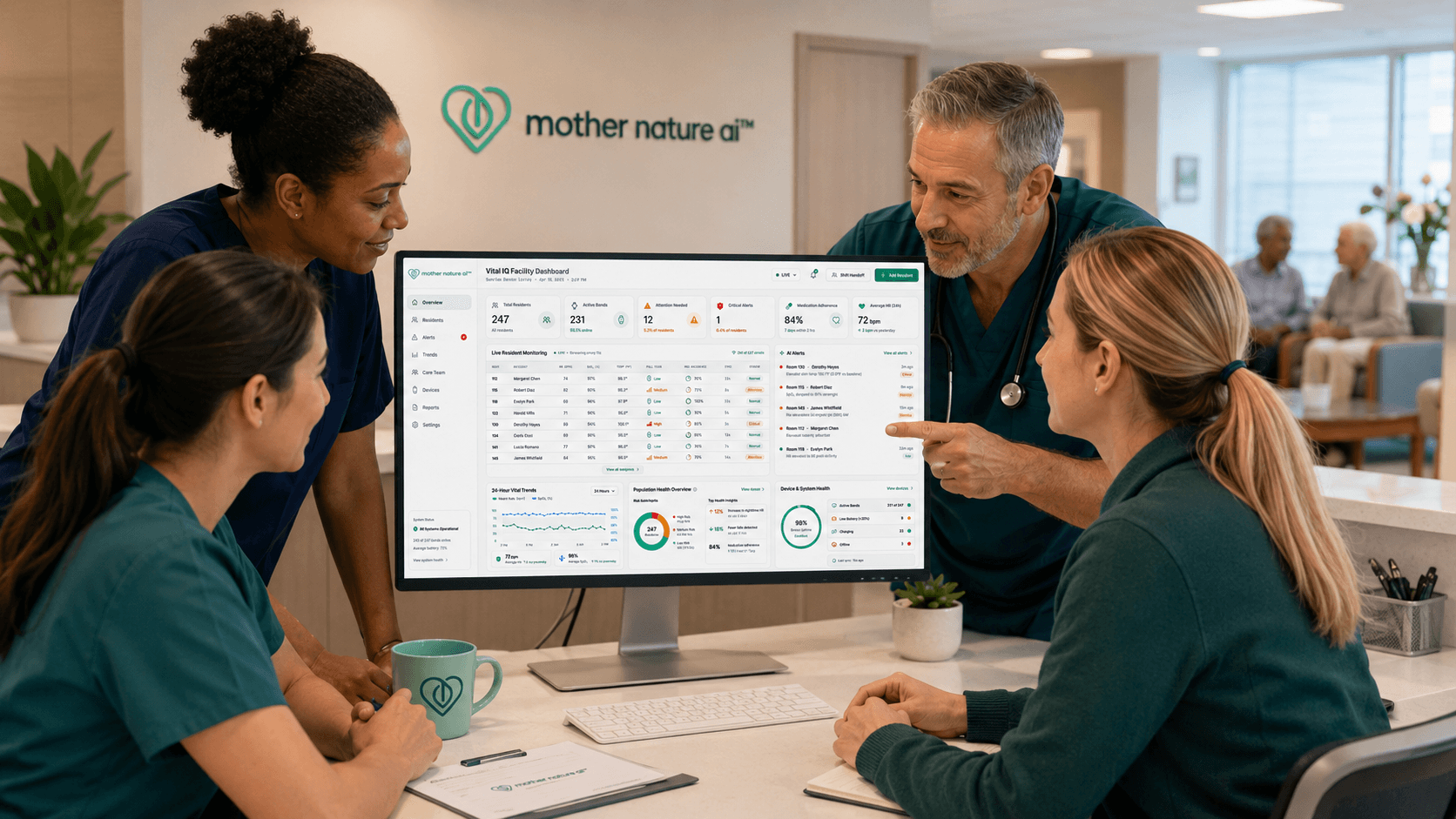
Most people picture nursing home care as a series of human moments: a nurse stepping into a room, an aide helping someone stand, a medication pass, a meal tray, a family member calling after dinner. That picture is not wrong. Care is still human work. But between those moments there is a lot of silence.
An older adult may sleep poorly for three nights before anyone has a reason to ask about sleep. Their activity may drift downward for a week before it becomes obvious in the hallway. A mild temperature trend may not look dramatic at a single check, but the pattern may matter when it appears beside lower movement, worse sleep, and a family member saying, "She just seems off." Remote patient monitoring in nursing homes exists for that in-between space.
The phrase can sound cold, like care is being outsourced to devices. That is not the point. The best version of remote patient monitoring does the opposite. It gives nurses, aides, administrators, families, and clinicians a shared picture of what is happening when nobody is standing in the room with a clipboard.
At Mother Nature AI, that is how we think about VitalIQ remote patient monitoring. Not as a replacement for care teams. Not as an alarm machine. Not as a promise that software can diagnose a resident from a wristband. VitalIQ is health data visibility infrastructure: wearable signals, facility dashboards, family access, and AI-assisted summaries designed to help people ask better questions earlier.
The old model: spot checks and memory
Most long-term care facilities already collect health information all day. The problem is that the information is scattered.
Aides notice whether someone ate breakfast. Nurses record vitals. Families hear a tone in a parent's voice. A physician sees the resident after a change has become significant enough to trigger a visit. A medication change may be documented in one system, a fall note in another, and sleep or activity may exist mostly as memory.
That system depends on heroic communication. It assumes everyone sees the same thing, remembers it the same way, and has time to hand it off cleanly. In real facilities, that is a hard ask.
Staff are stretched. Shifts change. Residents have good days and bad days. Family members call different people. A nurse may know a resident is "not quite herself," but the supporting pattern may be hard to prove. When did the change start? Was it sleep? Hydration? movement? medication timing? a respiratory issue? loneliness? pain? There may be clues, but they are not always in one place.
Remote patient monitoring is useful when it turns those loose clues into a timeline.
What a nursing home dashboard should actually do
A remote patient monitoring dashboard for a nursing home should not be a wall of blinking numbers. If every resident is always throwing alerts, staff will learn to ignore the dashboard. If the dashboard pretends every small change is urgent, it becomes noise. If it shows raw data without context, it creates work instead of reducing it.
A useful facility dashboard does a few quieter things well.
It shows whether devices are online. That sounds basic, but it matters. A wearable program fails if staff do not know who is charging, syncing, offline, or wearing the device incorrectly. Device status is not a technical detail. It is part of the care workflow.
It shows resident-level trends. A single heart rate or oxygen number can be misleading. A trend is more useful: what is normal for this person, what has changed, and how long has the change persisted?
It gives care teams a quick way to sort attention. Not every resident needs review at the same moment. A dashboard should help teams see who looks stable, who has a trend worth checking, and who needs a closer look under the facility's normal protocols.
It supports shift handoff. The most valuable dashboard in the world is less useful if it does not help the 7 a.m. team understand what the overnight team saw. Remote monitoring should make handoffs cleaner, not add another place to check.
It makes family conversations calmer. Families do not need a firehose of raw clinical data. They need appropriate visibility, plain-language summaries, and confidence that someone is watching the trends. That is a different design problem.
Why continuous wearable data is different from occasional readings
Remote patient monitoring often begins with episodic readings: a blood pressure cuff once a day, a pulse oximeter reading, a weight scale, a glucometer, a symptom survey. Those tools can be useful. They are also dependent on someone doing the task at the right time and recording it correctly.
Wearable data changes the shape of the problem because it is passive. The resident does not need to open an app. They do not need to remember to scan their face, hold a phone still, or type how they feel. The system watches trends in the background.
That matters most for older adults, because the people who would benefit from better monitoring are often the least likely to tolerate complicated devices. A smartwatch with notifications, tiny buttons, app updates, charging rituals, and a bright screen may be the wrong product for someone in memory care. A screenless wearable has a different job. It should disappear into the routine.
The goal is not to turn every resident into a quantified-self athlete. The goal is to understand baseline and drift.
Baseline is personal. One person's normal resting heart rate, sleep rhythm, step count, and activity pattern may look abnormal for someone else. Facility care is full of those differences. A resident who walks the halls every afternoon and suddenly stops is telling you something. A resident who rarely moves much but keeps the same pattern may not be.
Remote patient monitoring is strongest when it respects that individuality.
What trends can be useful without overclaiming
It is tempting in health tech to overstate what a dashboard can do. That is how companies get themselves into trouble and, more importantly, how they lose trust with the people doing the work.
A wearable dashboard should not claim to diagnose infections, predict falls with certainty, or replace a clinician. But it can still be valuable.
It can show that sleep has changed. In long-term care, sleep disruption is not a small thing. It may relate to pain, anxiety, medication timing, environment, nocturia, agitation, or illness. The dashboard does not need to know the cause to make the change visible.
It can show that activity is down. Lower movement may be temporary. It may also be the first visible sign that a resident is weaker, less engaged, more depressed, in pain, or becoming ill. Again, the point is not automatic diagnosis. The point is trend visibility.
It can show changes in resting heart rate or heart rate variability. Those signals are not magic. They are also not meaningless. In context, they can support the question every nurse already asks: is this person drifting from their usual baseline?
It can show device status. If a resident's band is offline, loose, or not syncing, the absence of data is itself a workflow item.
It can produce summaries. A well-written AI summary is not a medical opinion. It is a time saver. It might say, in plain language, that a resident's sleep has been shorter than usual for four nights, activity is down, and temperature trend is slightly elevated. A nurse or care manager can decide what that means.
The staffing reality nobody should ignore
The case for remote patient monitoring in nursing homes is not just technological. It is operational.
Facilities are being asked to care for more older adults with more complex needs while staffing remains difficult. Families expect more visibility. Regulators expect better documentation. Clinicians want clearer information. Administrators need systems that make care more consistent without burying staff in screens.
That is the uncomfortable reality behind the Remote Patient Monitoring category.
The answer cannot be "give nurses another dashboard and hope." If a monitoring system adds clicks, duplicate documentation, constant false alarms, and unclear responsibility, it will fail. The software has to respect the rhythm of the facility.
That means alerts should be configurable. Views should be role-based. Device management should be obvious. Summaries should be written in language a human would actually use. The system should fit shift handoff, family updates, and provider review. It should reduce the number of "Can someone check on this?" mysteries, not create more of them.
Families are part of the care loop now
One of the biggest shifts in senior care is that families expect to be connected. They are used to banking apps, location sharing, school portals, delivery tracking, and real-time everything. Then a parent enters a care facility and the family often feels like they have stepped back in time.
That does not mean families should see everything. Privacy matters. Consent matters. Facilities need boundaries. Staff should not be turned into a live customer-service desk for every normal fluctuation.
But families do need reassurance.
A weekly trend summary can be more calming than a vague "She's doing fine." A view that shows activity, sleep, and general status can reduce the anxious impulse to call repeatedly. A permission-based family app can help adult children feel connected without demanding that the resident manage technology.
This is where VitalIQ is intentionally different from a facility-only dashboard. We see remote patient monitoring as a shared care graph: the resident, the care team, the family, and eventually the clinician all looking at appropriate versions of the same underlying picture.
The family member does not need the same interface as the nurse. They need context, clarity, and restraint.
What care facilities should ask before adopting RPM
If you operate a nursing home, assisted living community, or memory care facility, the buying question is not simply "Does this collect vitals?" Many products collect vitals. The better questions are practical.
Will residents actually wear it? A device that older adults remove, forget, dislike, or cannot charge is not a monitoring system. It is an expensive pilot.
Can staff tell who is online? Device management needs to be visible. Otherwise the system slowly decays and nobody knows which data is reliable.
Does it create fewer interruptions or more? A dashboard that generates constant low-value notifications will not survive contact with real staffing.
Can it support family communication without overwhelming staff? Family access should be permissioned, plain-language, and designed to lower anxiety.
Does it fit clinical boundaries? The vendor should be clear about what the system does not do. If a company promises diagnosis, emergency prediction, or guaranteed prevention from wearable data alone, slow down.
Can the data be summarized? Raw numbers are only half the value. The useful output is a readable trend summary that helps a person decide what to review next.
Where VitalIQ fits
VitalIQ is our answer to a specific gap: consumer wearables are built for engaged users, while many remote patient monitoring systems are built around episodic clinical readings. Nursing homes and families need something in the middle.
They need passive data collection because residents should not have to operate the system.
They need a facility dashboard because care teams need a population view.
They need family access because loved ones want to stay connected.
They need AI summaries because nobody has time to interpret every graph from scratch.
And they need careful language because health data is serious. VitalIQ is not presented as a diagnostic device, emergency response system, or replacement for nurses. It is a visibility layer that can help the right people notice trend changes and communicate with more context.
That might sound less flashy than the usual health-tech pitch. Good. In senior care, trust is more important than flash.
The mistakes facilities should avoid
The easiest way to ruin a remote patient monitoring rollout is to treat it as a technology installation instead of an operational change.
The first mistake is launching with too many alerts. A new system is exciting, and it is tempting to turn on every notification because nobody wants to miss anything. In practice, that can make the dashboard unusable within a week. Staff need tiers of attention, quiet defaults, and a clear understanding of which signals deserve review under existing care protocols. If everything is urgent, nothing is.
The second mistake is skipping device ownership. Somebody has to know who checks bands, who handles charging, who replaces a device, who explains it to residents, and who answers family questions. If that job is vague, the program becomes unreliable and everyone blames the software.
The third mistake is showing families too much too soon. Families deserve visibility, but raw feeds can create anxiety when there is no context. A calmer rollout might start with weekly summaries, broad status, and permission-based sharing before exposing more detailed views.
The fourth mistake is forgetting the residents themselves. A resident may not care about "remote patient monitoring." They may care whether the band is comfortable, whether it looks embarrassing, whether it interrupts sleep, and whether it makes them feel watched. Adoption depends on those details.
The fifth mistake is using the dashboard as proof instead of a prompt. A trend is a reason to look closer, not a verdict. The best facilities will use RPM as one more source of context alongside staff observation, resident conversation, family input, and clinical judgment.
That is why the rollout plan matters as much as the product. Start with a focused group. Listen to staff. Watch alert volume. Adjust language. Build handoff habits. Give families a clear explanation of what they will and will not see. The technology should become part of the care rhythm, not a separate performance everyone has to maintain.
A better future for nursing home monitoring
The future of remote patient monitoring in nursing homes will not be one giant screen that tells everyone what to do. It will be quieter than that.
It will look like an overnight shift that can quickly see who was stable and who had a meaningful change.
It will look like a care manager starting a family call with a real trend summary instead of scattered notes.
It will look like a daughter checking on her father without feeling like she has to call the front desk every day.
It will look like a nurse seeing that a resident's sleep, movement, and temperature trend all changed together and deciding the person deserves a closer look.
It will look like better handoffs, fewer blind spots, and more shared context.
That is the promise of remote patient monitoring when it is built for the real world of nursing homes: not replacing human care, but giving human care a clearer signal.
VitalIQ is being built for that world. If you are exploring remote patient monitoring for a care facility, nursing home, assisted living community, or family member at home, you can learn more on the VitalIQ monitoring page or reach out through our provider page.