
How to Monitor an Aging Parent's Health Remotely Without Being Intrusive
A practical guide for families who want to monitor an aging parent's health remotely with dignity, consent, wearable trends, and calmer conversations.
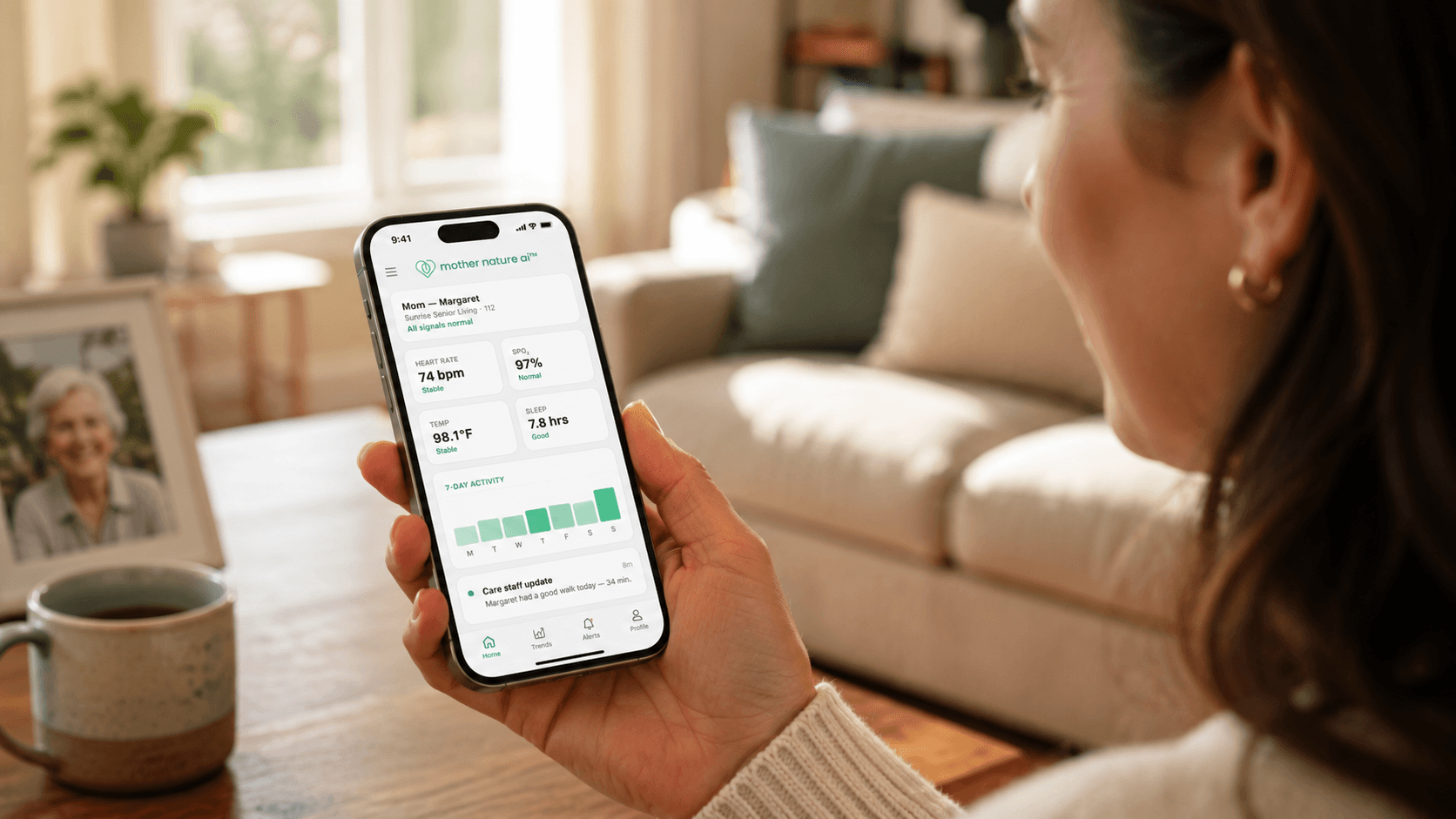
There is a particular kind of worry that comes with having an aging parent who still lives independently. It is not constant panic, exactly. It is more like a low hum in the background of the day.
You call and they sound tired. You ask if they slept and they say, "I'm fine." You notice they did not go to the usual Wednesday lunch. They tell you the weather was bad, or they forgot, or they just did not feel like it. Maybe that is true. Maybe it is nothing. Maybe it is the beginning of something.
Families do not want to spy on their parents. Most adult children are not looking for a dashboard because they enjoy dashboards. They are looking because the current options are terrible: call too often and feel like a nag, call too little and feel guilty, wait for a crisis and wish you had seen it coming.
Remote health monitoring for an aging parent should start from that emotional reality. The goal is not surveillance. The goal is gentler visibility.
At Mother Nature AI, we are building VitalIQ for families and care facilities because we think health data should reduce anxiety, not feed it. A family app should not make every normal fluctuation feel like an emergency. It should help everyone see trends, understand context, and have better conversations before a small change becomes a confusing scramble.
The first rule: your parent is not a project
If you take nothing else from this article, take this: the older adult is not a data source. They are a person with habits, privacy, pride, frustrations, and a lifetime of making their own decisions.
Remote monitoring goes wrong when families treat it like control. "Now I can see everything." "Now I know whether you walked today." "Now I can prove you are not sleeping." That tone will break trust quickly.
The better starting point is a conversation:
"I don't want to hover. I also worry because I love you. Would it help if we had a simple way to see broad health trends, so I don't have to keep asking the same questions?"
That sounds small, but it changes the whole frame. You are not installing a watchdog. You are agreeing on a shared signal.
Some parents will say no. That has to be respected. Some will say yes, but only if they control what gets shared. Good. That is how it should work. The right family health monitoring setup is permission-based, limited, and clear.
What families actually need to know
Most families do not need minute-by-minute data. In fact, too much raw data can make things worse. If you see every heart rate bump, every restless night, and every missed walk, you may become more anxious, not less.
What families need is trend context.
Is sleep changing? A few bad nights happen to everyone. A two-week shift is different.
Is activity dropping? One quiet day may mean rain. A pattern of lower movement may deserve a conversation.
Is resting heart rate different from normal? The number itself matters less than whether it is unusual for that person.
Is the wearable online? If the device is not syncing, the question is not medical. It is practical: does it need charging, adjusting, or replacing?
Are there plain-language summaries? A chart is useful for some people. A sentence is useful for almost everyone.
This is why we think remote health monitoring should be designed around "what changed?" rather than "what number is showing right now?" Numbers without context create false certainty. Trends create better questions.
Monitoring without hovering
The hardest part of caring for an aging parent is often the balance between safety and dignity. You want to know enough to help. You do not want your parent to feel watched.
That balance is easier when the app is designed with restraint.
A good family view should avoid noisy alerts. Not every small variation needs a push notification. If an app constantly buzzes the family, everyone becomes trained to either panic or ignore it. Neither is helpful.
It should use calm language. "Sleep has been shorter than usual this week" is better than "Warning: sleep anomaly detected." Families need clarity, not drama.
It should show summaries before raw data. A family member may want to drill into details sometimes, but the default view should answer the human question: does anything look meaningfully different?
It should support multiple sharing levels. A parent may be comfortable sharing sleep and activity, but not medication notes. They may share more with one family member than another. Privacy is not all-or-nothing.
It should make opt-in obvious. Hidden monitoring is a bad foundation for care. If a person is cognitively able to consent, they should understand what is shared.
The difference between independence and isolation
Families often wait too long to talk about monitoring because they are afraid of insulting their parent. Nobody wants to say, "I do not think you can handle living alone."
But remote health visibility does not have to be framed as a loss of independence. It can be framed as support for independence.
Living alone is not the same as being unsupported. A parent may still cook, drive, garden, see friends, and make their own choices while sharing basic health trends with a daughter, son, sibling, or trusted caregiver. In many cases, that visibility may help a person stay independent longer because small issues can be discussed before they become emergencies.
The language matters. "We want to keep tabs on you" feels insulting. "We want a way to know if something changes, so you can keep living the way you want with a little more backup" feels different.
That is the tone a product has to earn.
What to track, and what not to obsess over
If you are setting up remote monitoring for a parent, start with broad categories.
Sleep trends. Sleep affects mood, memory, balance, pain, blood pressure, immune function, and daytime energy. A parent may not remember exactly how they slept last week. A trend can help.
Activity and movement. For older adults, a drop in movement can be one of the clearest signals that something has changed. It may be weather, soreness, depression, illness, medication effects, fear of falling, or simple fatigue. The app does not need to know which one. It should help you notice the shift.
Resting heart rate and HRV. These are not diagnostic on their own. They can still add context, especially when they move alongside sleep and activity.
Temperature trend. Skin temperature is not the same as a clinical thermometer, but changes from a personal baseline can be useful context.
Medication routines. Many family worries are really medication worries. Did they take it? Did the dose change? Did a new medication start around the same time sleep got worse? That context matters. Mother Nature AI's broader product family includes medication-tracking work through Taper AI, and the long-term goal is to make this context easier to understand.
Device status. If the wearable is off, dead, or not syncing, the app should say so plainly. Missing data should never masquerade as normal data.
What should you not obsess over? One-off numbers. A single restless night. A weird reading from a loose wearable. A heart rate bump after climbing stairs. A normal person living a normal life produces messy data. The job is to notice meaningful patterns, not to interrogate every dot on the graph.
How to have the conversation
The best technology setup will fail if the human conversation is bad.
Start with the fear honestly, but do not make your fear the center of the conversation. "I worry about you" can be loving. "You make me worry" can sound like blame.
Ask what your parent wants. Maybe they are worried too. Maybe they hate the idea. Maybe they would be comfortable sharing a weekly summary but not daily details. Maybe they want their doctor involved. You will not know until you ask.
Explain the boundaries. What would you see? What would you not see? Who else would have access? Could they turn it off? Could they change permissions later?
Make it mutual. If your parent agrees to share health trends, consider agreeing to something in return: fewer repeated check-in questions, a scheduled weekly call, or a promise that you will not comment on every small fluctuation.
The product should help you keep that promise.
When a parent is in a care facility
The family dynamic changes when a parent moves into assisted living, memory care, or a nursing home. You may not be responsible for daily care anymore, but the worry does not disappear. Sometimes it gets worse because you are no longer physically there.
A family app can help when it gives appropriate visibility without bypassing the care team. The goal is not to turn every daughter or son into a second nurse. The goal is to make the family feel connected to the broad pattern of the person's day.
For example, a weekly summary might show that activity has been stable, sleep has improved, and the wearable is online. That can be enough. You do not need to call and ask three different staff members whether Mom is "really okay." You have a calm, shared starting point.
When something does change, the conversation can be more specific. "I noticed sleep has been shorter this week. Has anything changed in the evening routine?" That is a better question than "Is something wrong?"
This is where remote patient monitoring for care facilities and family monitoring overlap. The facility needs operational dashboards. The family needs reassurance and context. The resident needs dignity. The system has to serve all three.
Why wearables beat check-in apps for many older adults
Some remote care products ask the older adult to answer daily questions: How do you feel? Did you take your medication? Did you sleep well? Are you in pain? Those check-ins can be useful for people who like them.
But they are not enough for everyone.
Many older adults do not want another app. Some forget. Some tap through quickly. Some underreport because they do not want to worry their children. Some overreport because they are anxious. Some simply do not have the energy.
A wearable is not perfect, but it removes a lot of friction. It observes passively. It does not require typing. It does not ask the same question every morning. It gives the family and care team a baseline that does not depend entirely on memory.
That is why VitalIQ is built around continuous wearable signals rather than a daily survey alone.
What VitalIQ is designed to be
VitalIQ is being built for the everyday middle ground between "everything is fine" and "we have a crisis."
It is for the daughter who wants to know whether her father is sleeping and moving normally this week.
It is for the son whose mother is in assisted living and who wants a calmer way to stay connected.
It is for the family that wants to support independence without turning the home into a clinic.
It is for the care team that needs a shared view of trends without another noisy system.
VitalIQ is not a doctor. It is not a diagnosis engine. It is not an emergency response system. It is a health visibility layer: wearable data, trend summaries, family access, and dashboards that help people understand what changed.
That may sound simple. In practice, simple is the hard part.
A simple family agreement before you start
Before any device is purchased or any app is installed, it helps to write down a small family agreement. It does not need to be legalistic. It just needs to be clear enough that everyone knows what the monitoring is for.
Start with purpose. "We are using this so we can notice meaningful changes and support independence, not so we can criticize daily choices." Put that in plain language. If the purpose feels respectful, the rest is easier.
Then decide what gets shared. Maybe sleep, activity, heart rate trends, and device status are fine. Maybe medication reminders are private. Maybe location is off limits. Maybe one sibling gets access and another does not. These choices should not be guessed after the fact.
Decide what counts as follow-up. A single poor night of sleep should probably not trigger a family meeting. A week of lower activity might deserve a call. A device offline for two days might mean someone needs help charging it. Setting expectations prevents everyone from overreacting to normal life.
Decide how often you will talk about the data. A weekly check-in can be healthier than daily commentary. The parent should not feel like every number becomes a conversation. The adult child should not feel like they have to stare at the app all day.
Finally, decide how the agreement can change. A parent who is comfortable today may feel differently later. A new diagnosis may make more sharing useful. A move into assisted living may change the care team. Permissions should be revisited, not treated as permanent.
The agreement is not about paperwork. It is about preserving trust. Remote monitoring works best when it becomes part of a relationship that already has respect in it.
What to do when the data worries you
Sooner or later, something in the app may make you uneasy. Maybe sleep looks worse. Maybe activity is down. Maybe a trend summary says there has been a change from baseline.
Pause before reacting.
First, check whether the device data is complete. A loose wearable, low battery, or missed sync can make a chart look stranger than reality.
Second, look for patterns instead of one-off readings. One unusual day is not the same as a steady drift.
Third, ask your parent before you assume. "I noticed you have been sleeping less this week. Does that match how you feel?" is a better opening than "The app says something is wrong."
Fourth, involve professionals when the situation calls for it. Remote monitoring should support medical care, not replace it. If symptoms are concerning, if your parent feels unwell, or if something seems urgent, use the normal healthcare or emergency pathways.
The app is a flashlight. It is not the whole room.
A healthier way to worry
Worry is not going away. If you love an aging parent, some part of you will always listen for the change in their voice. Technology cannot remove that. It should not try to.
What it can do is make the worry more informed and less frantic.
Instead of asking, "Are you sure you're okay?" every other day, you can ask, "I saw sleep has been a little shorter this week. Anything bothering you at night?"
Instead of waiting for a vague feeling that something is off, you can notice that activity has drifted down and plan a visit.
Instead of treating independence and safety as enemies, you can build a quiet support system around the person your parent already is.
That is the kind of remote health monitoring we believe families actually need: consent-based, privacy-first, plain-spoken, and human enough that it does not make love feel like surveillance.
Learn more about VitalIQ for families and care facilities, or explore how Mother Nature AI is building the broader health AI platform that connects wearable trends, records, medication context, and trusted health guidance.